Which parts are real
The Spartan material is real: barley and figs, reed mats, the deliberate underfeeding that teaches boys to steal, the mother's instruction to return with the shield or on it. Xenophon and Plutarch, not the movie version.
Every god, place, weapon and custom named in the book is here. Where a name is attested in surviving Greek sources, the entry says so. Where it appears nowhere but in this scroll, it says that instead.
Start here
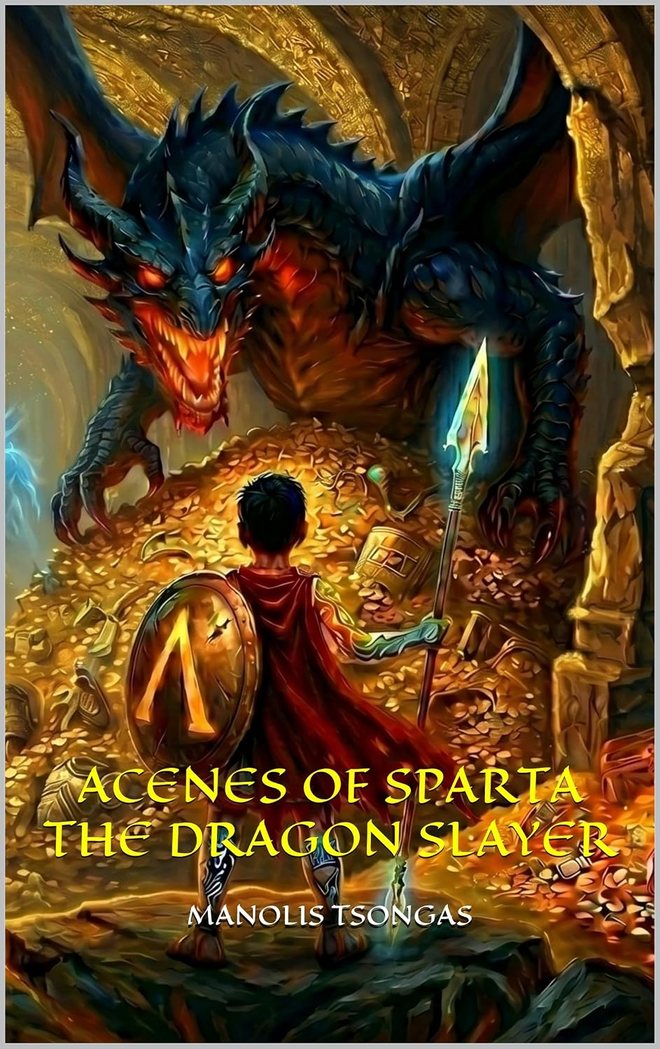
- AcenesA seven-year-old Spartan boy who becomes the subject of this account.
- KalaxesAn ancient dragon with midnight-blue scales and golden eyes.
- AgogeThe rigorous education and training program in ancient Sparta that all male citizens underwent from age seven to thirty.
- Stealing in the agogeThe most misread element of Spartan upbringing.
- King LeonidasThe legendary Spartan king who led the 300 at Thermopylae.
- CarneiaThe festival of Apollo Carneus, and the reason Sparta sent three hundred men to Thermopylae instead of an army.
- HelotsThe subject population of Laconia and Messenia, bound to the land and to the Spartans collectively rather than owned as.
- KrypteiaThe secret service, or the secret thing.
- TresantesThe tremblers.
- CyniscaDaughter of the Spartan king Archidamus, sister of Agesilaus, and the first woman to win at Olympia.
- Artemis OrthiaA sanctuary on the bank of the Eurotas, and the site of the most notorious Spartan ritual.
- SyssitiaThe common mess.
Every entry
A
- AcenesA seven-year-old Spartan boy who becomes the subject of this account.
- AegisAthena's magical shield bearing the head of Medusa.
- AgogeThe rigorous education and training program in ancient Sparta that all male citizens underwent from age seven to thirty.
- Amulet of ZeusLeonidas' artifact used to bind Kalaxes.
- ApothetaeThe place of discarding.
- AresGod of war, whose spear Medea wields against Kalaxes.
- ArgosOdysseus' faithful dog mentioned in comparison to the Laconian hound that finds Acenes.
- Artemis OrthiaA sanctuary on the bank of the Eurotas, and the site of the most notorious Spartan ritual.
- Asphodel, Fields ofThe region of the Greek underworld where ordinary souls who were neither heroic nor evil spend eternity.
- AthenaGoddess of wisdom, strategic warfare, and crafts.
- Athena's BirthAccording to Greek mythology, Athena's birth was extraordinary.
- AthensA powerful Greek city-state and traditional rival to Sparta.
B
- BarbariansIn the context of ancient Sparta and Greece, "barbarians" referred to all non-Greek-speaking people.
- BellerophonThe legendary hero who tamed the winged horse Pegasus and slew the monstrous Chimera.
- Birds of AresThough not directly mentioned in this story, these mythical creatures guarded Amazons in Greek legend and could serve as scouts.
- Black brothMelas zomos, the dish that made Spartan food proverbial.
- BoeotiaA region of central Greece containing several important city-states, including Thebes.
C
- CadmusThe legendary founder of Thebes who slew a dragon and, under Athena's guidance, sowed its teeth in the ground.
- CarneiaThe festival of Apollo Carneus, and the reason Sparta sent three hundred men to Thermopylae instead of an army.
- CerberusThe three-headed hound that guards the entrance to the Greek underworld, preventing souls from escaping back to the world of the.
- CharonThe ferryman of the dead in Greek mythology who transports souls across the River Styx to the underworld.
- CorinthA wealthy Greek city-state located on the isthmus connecting the Peloponnese to mainland Greece.
- CyniscaDaughter of the Spartan king Archidamus, sister of Agesilaus, and the first woman to win at Olympia.
D
- Divine TattoosMagical markings placed on Acenes by Zeus (right arm), Poseidon (left arm), and Athena (legs).
- DolphinsSea mammals sacred to Poseidon that rescue Acenes after the shipwreck.
- Dragon Chariot of MedeaA golden chariot drawn by winged serpents (Drakones), gifted by Helios.
- Dragon CorruptionThe magical taint transferred through Kalaxes' death fire that manifests in Alcibiades after death.
E
- EirenA youth of about twenty placed in command of a troop of younger boys.
- ElysiumThe region of the Greek underworld reserved for heroes and those blessed by the gods.
- EphesusA major Greek city in Ionia (modern-day Turkey) known for its wealth and the Temple of Artemis, one of the Seven Wonders of the.
- EphorOne of five annually elected magistrates who formed the most powerful governmental body in ancient Sparta.
- Erinyes (Furies)Ancient chthonic deities of vengeance who punish those who commit crimes against the natural order, particularly kin-slaying.
G
- GerousiaThe council of elders.
- GigantomachyThe great war between the Olympian gods and the Giants, mentioned by Prometheus when explaining the origin of Leonidas' weapons.
- Golden Olive BranchA sacred relic in Athena's temple, said to have been touched by the goddess herself during the shrine's consecration.
- Golding ProcessKalaxes' unique ability to transform living beings into gold statues, as demonstrated with the merchant in "The Hoard" chapter.
- GymnopaediaeThe festival of naked youths, held in high summer in the Spartan agora.
- GyrosThe bearded pirate captain who captures Acenes with the intention of selling him as a slave in Ephesus.
H
- HadesGod of the underworld and ruler of the dead.
- Hades' PalaceThe impossibly architected central structure of the underworld, described as having corridors that extend beyond possible.
- HeliosAs Medea's grandfather and chariot-giver, his absence from Kalaxes' imprisonment suggests the dragon's rejection of solar.
- HelotsThe subject population of Laconia and Messenia, bound to the land and to the Spartans collectively rather than owned as.
- HephaestusGod of fire, metalworking, and craftsmanship.
- HeraQueen of the gods and wife of Zeus.
I
- Iron moneySparta issued no silver coinage in the classical period, and Plutarch explains the absence as deliberate: Lycurgus withdrew gold.
K
- KalaxesAn ancient dragon with midnight-blue scales and golden eyes.
- Kalaxes' TreasuryThe vast collection of golden statues and mythological creatures described in "The Hoard" chapter.
- KarkinosThe pirate ship that captures Acenes, named after the crab constellation.
- King LeonidasThe legendary Spartan king who led the 300 at Thermopylae.
- King XerxesThe Persian ruler who employed Kalaxes against the Greeks.
- KrypteiaThe secret service, or the secret thing.
L
- Laconian ExpressionThe Spartan practice of speaking with extreme brevity and directness, avoiding unnecessary words.
- Laconian HoundsThe hunting dogs bred specifically for Spartan use that appear in "Night of the Hound." These dogs were known for their.
- Laconic speechNamed from Laconia, and attested as a Spartan habit by writers who were not Spartan.
- Lambda ShieldSpartan shields bore the Greek letter lambda (Λ), standing for Lacedaemon, another name for Sparta.
- LycurgusThe semi-legendary lawgiver who established Sparta's distinctive political and social system.
M
- MoiraiThe three Fates who measure and determine the thread of every mortal life: Clotho (spinner), Lachesis (measurer), and Atropos.
- Mount OlympusHome of the Greek gods, where Zeus and Poseidon debate Acenes' fate.
- Mount TaygetusA mountain range in the Peloponnese near Sparta, featured in this account during the earthquake that leads Acenes to discover.
N
- NemesisThe Greek concept of divine retribution or cosmic justice, personified as the goddess who punishes excessive pride (hubris) and.
O
- OdrysiansA powerful Thracian tribal kingdom that flourished from the 5th to 3rd centuries BCE in what is now parts of Bulgaria, Greece.
- Olive TreeAthena's sacred tree that features prominently in her shrine and later in her tattoos on Acenes' legs.
- OlympiadThe four-year period between Olympic Games, used as a unit of time measurement in ancient Greece.
- OracleA person or shrine through which the gods delivered prophecies and guidance.
P
- PaidonomosThe warden of the boys.
- ParthenonThe temple of Athena Parthenos on the Acropolis of Athens, represented in Athena's tattoo on Acenes' leg.
- Peloponnesian WarThe real conflict (431-404 BCE) between Athens and Sparta, echoed in Alcibiades' fictional plot to destabilize Greece.
- PersianReferring to people or things from Persia (modern-day Iran), which was the dominant empire in the Near East and the traditional.
- PiratesSeafaring raiders who operated throughout the Mediterranean, often with bases on small islands.
S
- SpartaA militaristic Greek city-state known for its warrior culture and austere lifestyle.
- SpartanA citizen of Sparta, renowned for their military prowess, discipline, and austere lifestyle.
- Spartan MenSpartan men were raised from birth with one purpose: military excellence in service to their state above all else.
- Spartan Men and WomenSpartan society was unique in ancient Greece for the mutual respect and admiration between men and women.
- Spartan MotherSpartan women, including mothers, held a unique position in ancient Greek society.
- SpartoiWarriors born from dragon's teeth sown by Cadmus, founder of Thebes.
- Spear of AresThe weapon Medea uses against Kalaxes.
- Spear of TheseusA divine weapon originally used by Theseus during his journey into the labyrinth, it was specially crafted to penetrate immortal.
- SphinxA mythological creature with the head of a human, body of a lion, and sometimes wings of an eagle.
- Stealing in the agogeThe most misread element of Spartan upbringing.
- StoicismA Hellenistic philosophy that had its origins in the "practical wisdom of the Spartans," as well as other schools of philosophy.
- Styx, RiverThe principal river of the Greek underworld, forming the boundary between the world of the living and the realm of the dead.
- SusaAn ancient city of the Persian Empire where King Xerxes held court.
- SyssitiaThe common mess.
T
- TartarusThe deepest, most terrible region of the Greek underworld where the wicked are punished and the most dangerous beings are.
- ThebesA powerful Greek city-state in the region of Boeotia.
- ThermopylaeThe narrow coastal pass where Leonidas and his 300 Spartans made their famous last stand against the Persian army.
- Treasury of JudgmentA chamber in Hades' palace described as "a perfect hexagon whose walls, floor, and ceiling appeared constructed from solid gold,".
- TresantesThe tremblers.
- TyphonIn Greek mythology, the "Father of Monsters" and most deadly creature ever born.
W
- War for AthensThe mythological contest between Athena and Poseidon for patronage of the city of Athens.
- With it or on itThe instruction a Spartan mother is said to have given her son as she handed him his shield: come back with this, or on it.
Z
- ZeusKing of the Greek gods and ruler of Mount Olympus.
Other
- "Come and take them!"Famous response attributed to Leonidas when the Persians demanded the Spartans surrender their weapons.
- "For Sparta"The battle cry and dedication of Spartan warriors, emphasizing their commitment to the state above individual concerns.
- "Return with your shield or on it"A famous Spartan saying mothers would tell their sons before battle, meaning come back victorious (with your shield) or dead.